
The Temple of Hathor at Dendera: A Journey Through Egypt’s Best-Preserved Gem
Dendera Temple Complex stands as one of the most breathtaking and intact monuments to survive from ancient Egypt. While the pyramids speak of eternity and the tombs of the Valley of the Kings whisper of the afterlife, Dendera sings a vibrant, colorful hymn to the gods of life, love, and the cosmos. As an Egyptologist who has walked its halls countless times, I find that its preservation is so remarkable that you don’t need to imagine its former glory—you stand directly within it.
This sprawling complex, dedicated primarily to the goddess Hathor, is a palimpsest of history, with layers from the Old Kingdom, through the Ptolemaic era, and into the Roman period. Its walls are a library in stone, containing advanced astronomical charts, enigmatic reliefs that have sparked modern debates, and the faces of gods and pharaohs that gaze upon you with timeless serenity. Let’s explore this magnificent site, separating established archaeology from popular mystery.
Historical Foundations: More Than Just a Ptolemaic Temple
The common perception is that Dendera is a Ptolemaic temple, and indeed, the magnificent structure we see today was largely built from 54 BCE onward under rulers like Ptolemy XII Auletes and Cleopatra VII. However, to label it only as such is to miss three millennia of history.
Archaeological evidence confirms sacred activity here dating back to the Old Kingdom, around 2250 BCE, possibly initiated by Pharaoh Pepi I. For centuries, Dendera was not just a temple but a major population center and a vast necropolis. Recent excavations led by the Institut français d’archéologie orientale and Macquarie University are uncovering the extensive “city of the dead” south of the temple walls, with tombs spanning from the Early Dynastic Period to the Roman era. This ongoing work reminds us that the temple was the beating heart of a living, breathing community.
The current Temple of Hathor was completed under the Roman emperors. Walking through the monumental gateway built by Domitian and Trajan, you are greeted by the surreal sight of Roman emperors depicted in the traditional regalia of Egyptian pharaohs, making offerings to Hathor. This was a powerful political and religious statement, showcasing the Romans’ desire to legitimize their rule by embedding themselves within Egypt’s divine framework.
Architectural Marvel: A Walk Through the House of Hathor
Entering the temple is an unforgettable experience. You pass through the great mudbrick wall that encloses the 40,000-square-meter complex and into the domain of the goddess.
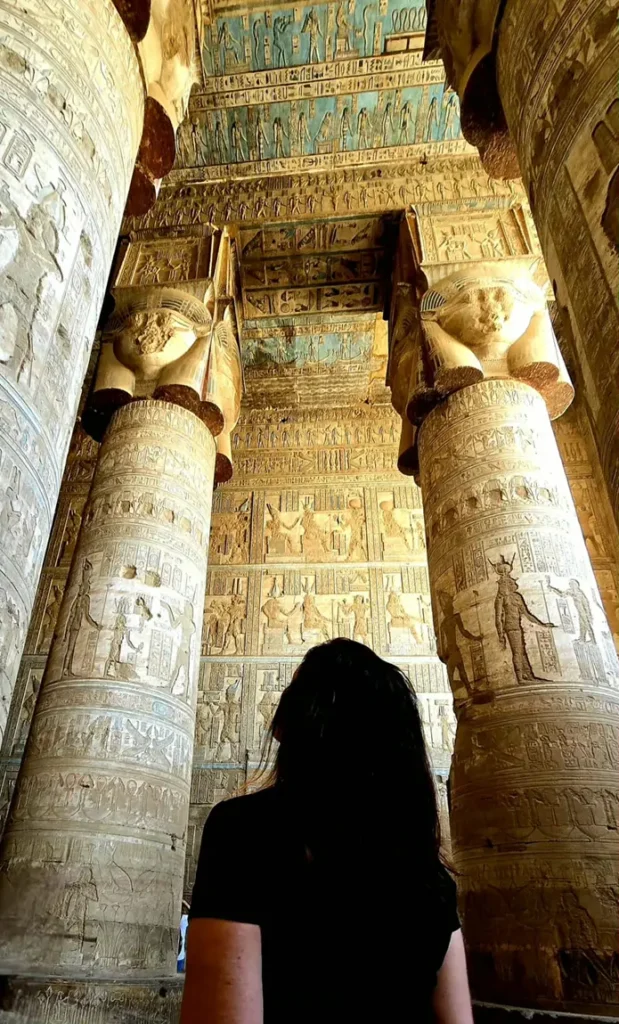
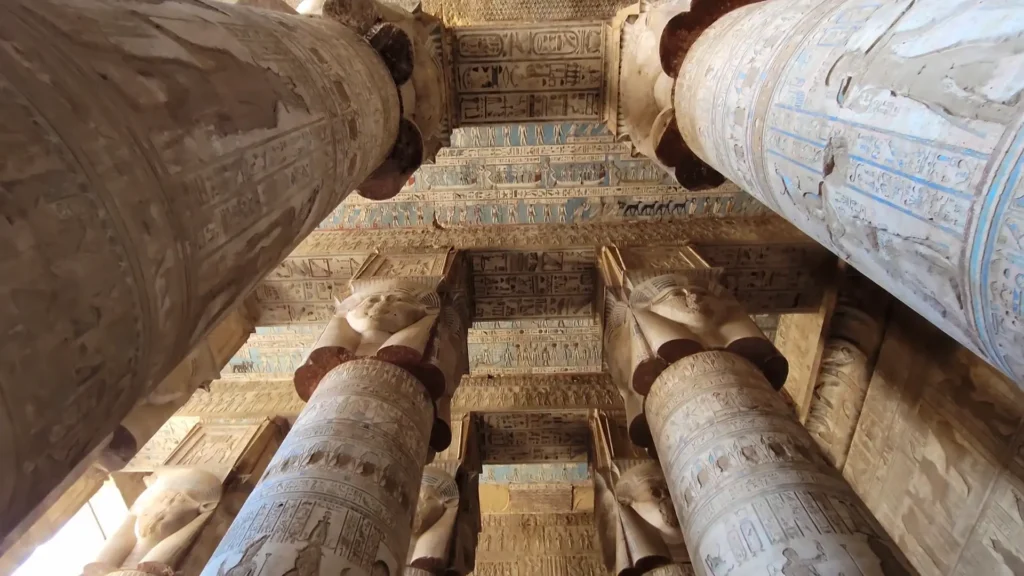
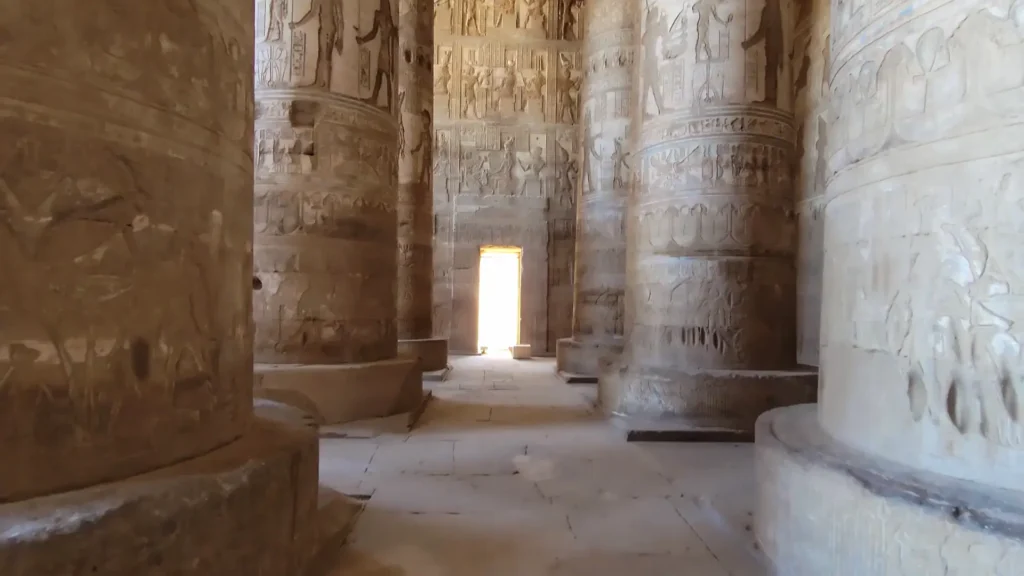
- The Hypostyle Hall: Your first stop is the stunning Great Hypostyle Hall, added under Emperor Tiberius. Twenty-four massive columns rise 15 meters high, each topped with the iconic Hathoric capital—the carved face of the goddess with the ears of a cow, framed by a sistrum (her sacred rattle). The ceiling overhead is a masterpiece of ancient Egyptian astronomy. Despite centuries of soot, recent restoration work by the Supreme Council of Antiquities has revived its original brilliant blues, yellows, and reds. Here, the sky goddess Nut swallows the sun in the evening to give birth to it again at dawn, surrounded by zodiacal signs and star charts.
- The Sacred Chambers: Beyond the hall lies a labyrinth of smaller rooms—the laboratory for preparing sacred unguents, the treasury, offering halls, and a series of eleven shrines dedicated to various deities associated with Hathor’s cult. The innermost sanctuary once housed the gilded cult statue of Hathor. Only the high priest and the pharaoh were permitted to enter this, the most sacred space.
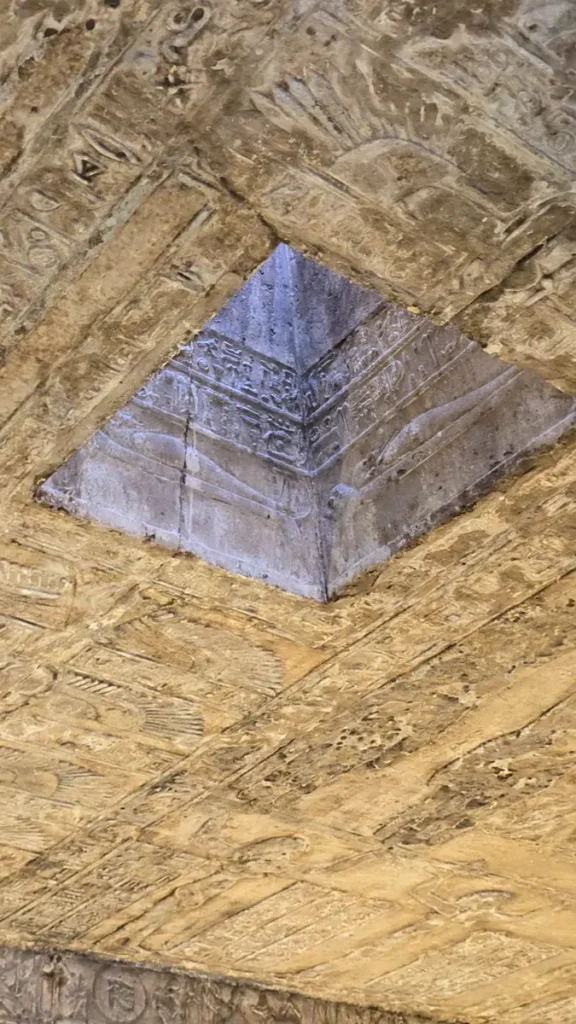
- The Crypts: Perhaps the most fascinating areas are the subterranean crypts. Accessed by narrow, descending passageways, these twelve hidden chambers were used to store the temple’s most precious ritual objects and votive offerings. The walls here are carved with exquisite reliefs, including one showing Pharaoh Pepi I from the Old Kingdom offering a statuette to Hathor, a direct link to the site’s earliest iterations.
- The Roof and the Zodiac: A staircase, worn smooth by millennia of priests’ feet, leads to the temple roof. Here, in open-air chapels, key rituals in the Osirian cycle were performed. It was from a ceiling in one of these rooftop chapels that the famed Dendera Zodiac was removed in 1821 and sent to the Louvre in Paris. The circular bas-relief is a unique fusion of Egyptian and Greco-Babylonian astronomy, depicting the constellations, including the signs we recognize today like Taurus and Libra. Modern astrophysicists have analyzed its configuration and dated the specific celestial arrangement it shows to between June and August of 50 BCE. A replica now sits in its place, but the original’s removal remains a point of contention.
The Mysteries: “The Dendera Light” and the Sacred Lake
No discussion of Dendera is complete without addressing its two great “mysteries,” one born of modern speculation and the other of ancient healing faith.
- The So-Called “Dendera Light”: In a crypt, a peculiar relief shows a snake emerging from a lotus flower held aloft by a djed pillar (a symbol of stability), enclosed within an oval container. To some, this resembles a giant light bulb with a filament, leading to fantastical theories about ancient Egyptian electricity. Mainstream Egyptology firmly rejects this. The relief is a symbolic representation of the god Harsomtus (a form of Horus) as a snake, symbolizing primordial energy and creation, born from the lotus (which represents creation) within the womb of the sky goddess. It is a profound theological statement, not a technical diagram.
- The Sanatorium and Sacred Lake: Dendera was a center of healing pilgrimage. The complex housed a sanatorium, where the sick would bathe in sacred waters or spend the night in hopes of receiving curative dreams from the goddess Hathor. Water from the temple’s Sacred Lake, used in rituals, was also considered blessed and therapeutic. This shows us that Hathor’s domain extended beyond joy and music into compassionate, practical care for her devotees.
Visiting Dendera Today: A Practical Guide for the Modern Traveler
Dendera is located about 60 km north of Luxor, near the modern city of Qena. It is most easily visited as a day trip by taxi or organized tour from Luxor. Unlike the crowds at Karnak or the Valley of the Kings, Dendera often offers a more contemplative experience.
- What to See: Don’t rush. Allocate time to explore the main temple’s interior, ascend to the roof for spectacular views, and if accessible, descend into the atmospheric crypts. Outside the Hathor temple, explore the Roman mammisi (birth house), the Temple of the Birth of Isis, and the remains of a 5th-century Coptic basilica, which testifies to the site’s continued sacred importance.
- Recent Discoveries: Archaeology here is alive. As recently as March 2023, a charming limestone sphinx, thought to represent the Roman Emperor Claudius, was unearthed near the temple. Ongoing restoration and research mean the site continues to reveal new secrets.
Conclusion: The Eternal Legacy of the House of Hathor
The Dendera Temple Complex is more than a collection of old stones. It is a testament to enduring faith, a monument built, expanded, and revered for over 2,000 years by Egyptians, Greeks, and Romans alike. Its art and architecture represent the final, glorious flowering of ancient Egyptian temple design, perfectly preserved under the desert sands.
Standing in the hypostyle hall, bathed in the colored light filtering from the high clerestory windows, you are sharing space with ancient priests, Roman emperors, and countless pilgrims. You are in the enduring house of Hathor, goddess of love, beauty, and the joyful cosmic order—a place where the heavens are painted on the ceiling and the energy of creation is carved into the walls. It is, in my professional and personal opinion, an unmissable key to understanding the spiritual and intellectual world of ancient Egypt.